
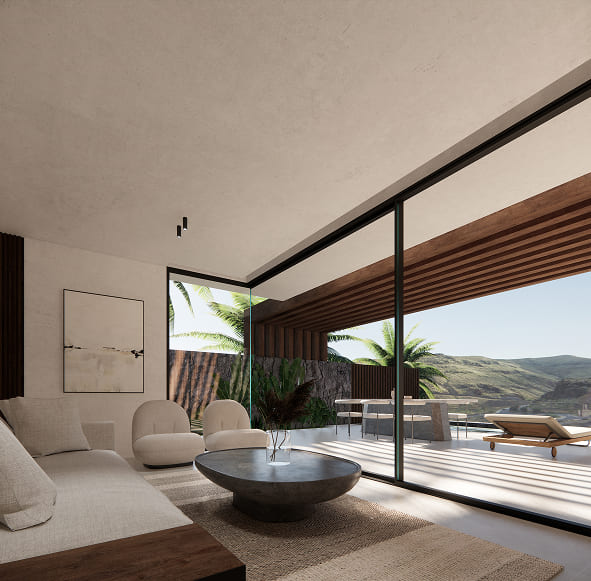
When buyers compare luxury properties for sale, the price per square metre often appears to offer clarity. In reality, it can flatten the very qualities that create value in the prime segment: light, silence, views, materials, privacy, and long-term resilience. A larger home is not always a finer asset, and a smaller villa may hold greater appeal if it is beautifully placed and intelligently built. At Ávalos, we have spent several years shaping a resort-led vision of sustainable luxury in the Canary Islands, and this article explains what truly deserves attention.
The metric is useful — but never sufficient
The price per square metre is a convenient first filter, yet it was designed for comparison, not for understanding. It can help identify broad market positioning, but it cannot explain why one villa feels calm, private, and rare, whilst another of similar size feels ordinary. In luxury, value is often concentrated in scarcity: an open sea view, a protected natural setting, an elevated plot, or a sense of arrival that cannot be recreated elsewhere.
This is especially true in the Canary Islands, where micro-location matters intensely. A villa near the ocean may command attention, but its true worth depends on orientation, shelter from wind, sun exposure, access, and how naturally the architecture belongs to its landscape. For this reason, buyers should understand the wider setting before judging the number alone. The setting of Ávalos in La Gomera illustrates how place, privacy, and access work together rather than competing with one another.
Materials, build quality, and the cost of time
Luxury is not only what is visible on completion day. It is also what still performs beautifully five, ten, and fifteen years later. High-quality materials, marine-resistant finishes, thoughtful waterproofing, efficient glazing, and durable exterior surfaces may not enlarge the floor area, but they can significantly improve comfort, maintenance, and perceived value. The difference between cosmetic specification and genuine build quality is often revealed slowly.
A serious buyer should therefore ask not only what the property costs, but how it will age. In a coastal environment, the maintenance profile is part of the investment case. So are energy efficiency, ventilation, insulation, and the ease with which ownership is managed from abroad. A clear luxury villa purchase process should help buyers understand specification, ownership structure, and practical responsibilities before any comparison becomes meaningful.
A practical lens for comparing luxury villas
If you are building a luxury home buying checklist, the most revealing questions are rarely limited to size. They concern daily experience, technical integrity, and future liquidity. Here is what to consider when buying a luxury property, particularly in an island destination where climate, views, and services shape value.
- Light and orientation: Morning sun, protected terraces, and naturally bright living spaces often create more value than surplus enclosed metres.
- Privacy and acoustics: Distance from neighbouring buildings, controlled sightlines, and quiet surroundings influence both wellbeing and resale appeal.
- Indoor-outdoor living: Terraces, pools, shaded dining areas, and open-plan continuity can make a villa feel generous without unnecessary scale.
- Operational resilience: Efficient systems, robust finishes, and professional maintenance protect comfort, rental performance, and long-term ownership.
Services, management, and legal clarity
In the prime segment, a villa is increasingly valued not as an isolated object, but as part of an experience. Resort facilities, wellness spaces, access to nature, hospitality standards, and professional management can transform how the asset is used and perceived. For international buyers, this matters because enjoyment and practicality must coexist. A beautiful property that is difficult to manage may lose some of its appeal over time.
Legal and operational structure should also be examined with care. The value of a villa may be strengthened by regulated use, transparent contracts, clear maintenance obligations, and a coherent asset strategy. In projects designed for holiday use or rental participation, buyers should look beyond headline returns and consider governance, guarantees, flexibility, and the quality of day-to-day execution.
Value is measured in experience, resilience, and confidence
A more mature approach begins with disciplined comparison. Instead of asking which property offers the lowest cost per metre, ask which property offers the strongest combination of setting, design, comfort, management, and exit appeal. This is where long-term valuation becomes more than a spreadsheet. It becomes a judgement about desirability over time.
At Ávalos, the philosophy is to recognise luxury as a balance of architecture, nature, hospitality, and responsibility. The aim is not to make the largest statement, but to create quiet confidence through proportion, light, sustainability, and considered ownership. Buyers who want to understand this approach can learn more about the Ávalos philosophy and project credentials. In the end, the finest metres are not simply counted — they are lived, maintained, and valued through time.
If comparing villas by size alone — and wanting a clearer view of value, use, and long-term structure — resonates with you, we would be glad to discuss the principles that matter. Explore the Ávalos investment structure.
Frequently asked questions about what to look beyond the price per square metre
Why can price per square metre be misleading in luxury real estate?
Price per square metre does not capture rarity, views, privacy, craftsmanship, services, or legal structure. In the luxury segment, these factors often shape value more than size alone.
What matters most when comparing luxury villas in the Canary Islands?
Buyers should assess orientation, micro-climate, natural light, privacy, build quality, outdoor living, access, and management. These elements influence both lifestyle and long-term valuation.
Should a smaller villa ever be more valuable than a larger one?
Yes. A smaller villa with sea views, refined materials, intelligent design, and professional resort services may offer stronger appeal than a larger property with weaker fundamentals.
How should I create a luxury home buying checklist?
Begin with setting, light, materials, legal clarity, operational costs, rental management, and resale potential. A good checklist should measure lived quality as well as technical and financial strength.