
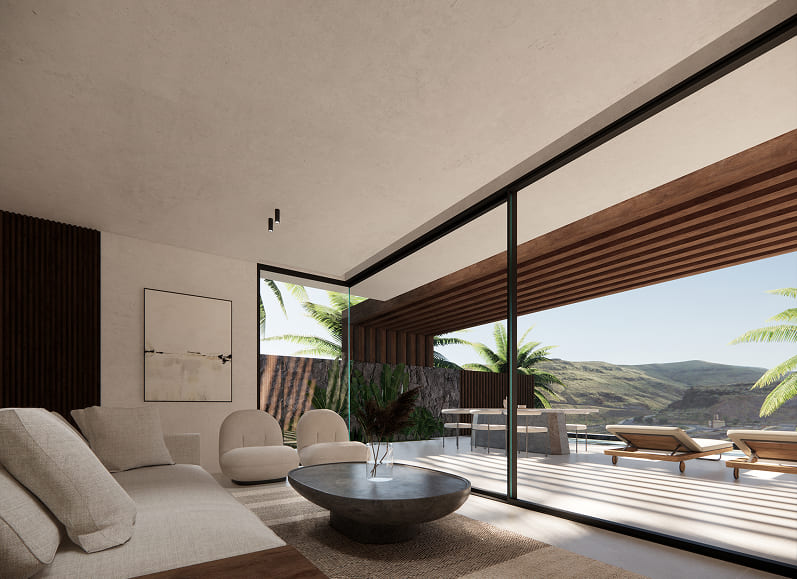
The question arises more often than one might expect — and it deserves a considered answer. Sophisticated buyers approaching the premium property market for the first time frequently encounter the term “luxury” applied with considerable latitude. Not every well-appointed property qualifies. At Ávalos, we have spent years refining our understanding of what genuinely distinguishes a luxury villa from a well-presented conventional home — and the criteria are more specific, and more meaningful, than most listings acknowledge.
Before deciding: what very few buyers stop to consider
The most common misconception is that luxury is primarily a question of size or price. In reality, these are necessary but insufficient conditions. In markets such as Spain, the threshold for “luxury” typically begins around €1 million — with ultra-luxury properties exceeding €5 million — yet many properties within that range offer little beyond scale.
What separates a genuinely exceptional villa is the convergence of several independent criteria: location that cannot be replicated, architecture that was designed rather than built, and a quality of daily life that actively improves your experience of being there. When any one of these is absent, the result is an expensive conventional home — not a luxury villa.
Criterion 1 — Location and architectural identity
A conventional home is positioned for practicality: proximity to schools, transport links, commercial amenities. A luxury villa, by contrast, occupies a location chosen for its irreproducibility — a seafront position, a hilltop with unobstructed panoramic views, a secluded estate within a protected natural environment. The location is not incidental; it is the foundation of the asset’s value and the daily experience of living there.
Architecture follows the same logic. Where conventional homes follow functional templates, luxury villas are conceived by acclaimed architects as singular objects — with high ceilings, considered façades, open-plan volumes and the use of noble materials: imported marble, fine timber, hand-finished surfaces. The result is a property with a distinct identity that cannot be found elsewhere. At Ávalos, each villa at Bahía de Ávalos is designed to frame the Atlantic landscape, not to compete with it.

Criterion 2 — Technology, amenities and the quality of daily life
The gap between a primary residence and a luxury villa becomes most apparent in everyday experience. Conventional homes offer standard comfort; luxury villas are engineered for a different quality of life entirely. Smart home automation — controlling climate, lighting, security and entertainment from a single device — is now a baseline expectation, not a premium feature. Beyond technology, the distinction lies in amenities that redefine what a private residence can offer:
- Private infinity pools and spa facilities — not shared, not communal; exclusively yours, maintained to resort standard.
- Home cinema and temperature-controlled wine cellars — features that reflect a considered approach to leisure within the home itself.
- Dedicated service teams — villa managers, private chefs, housekeepers and concierges who adapt to your preferences, creating a hotel-quality experience within a private residence.
- Strategic landscaping and 24/7 professional security — privacy is designed in, not assumed; the property functions as a genuine sanctuary from public life.
You can explore how the Ávalos ownership model integrates professional management and curated services as a standard part of the proposition.
The most common mistakes — and how to avoid them
Buyers entering the luxury market for the first time frequently encounter the same avoidable errors. The following are those we observe most consistently:
- Equating size with luxury. A large property in an unremarkable location remains a large conventional home. Scale amplifies the value of the other criteria — it does not replace them.
- Overlooking the service model. A villa without professional management requires the owner to manage it as a property, not experience it as a lifestyle. The quality of the hospitality infrastructure matters as much as the architecture.
- Underestimating the role of privacy. In a conventional home, privacy is a function of proximity to neighbours. In a luxury villa, it is a design principle — built into orientation, landscaping, access control and the nature of the location itself.
- Treating investment value as secondary. A luxury villa in a UNESCO-protected, low-density environment — such as La Gomera — benefits from structural scarcity. Planning restrictions limit new supply, which supports long-term asset value in ways that conventional residential markets rarely offer. The Ávalos purchase framework is built around this understanding.
If the distinction between owning a property and inhabiting a genuinely exceptional one has begun to clarify — and you are considering what that might look like in one of the Canary Islands’ most protected natural settings — we would be glad to accompany you through the next step. Explore the Ávalos investment and lifestyle proposition here.
Frequently asked questions about luxury villas vs conventional homes
What makes a villa officially "luxury" rather than simply expensive?
Price is a threshold, not a definition. A property is genuinely considered luxury when it combines a privileged and irreproducible location, bespoke architectural design, premium materials and amenities, and access to personalised services — all operating at a level that a conventional home cannot replicate regardless of budget.
What is the difference between a primary residence and a holiday home in the luxury market?
The distinction is increasingly blurred amongst discerning buyers. Many luxury villas are acquired as secondary residences that function simultaneously as personal retreats and income-generating assets. The key difference lies in the ownership model: a primary residence is managed personally, whilst a luxury holiday villa typically includes professional management, rental potential and resort-level services that make it productive in the owner’s absence.
Do luxury villas hold their value better than conventional homes?
In carefully selected locations — particularly those with planning restrictions, natural protections or genuine scarcity of land — luxury villas tend to demonstrate greater value resilience than conventional residential property. La Gomera’s status as a UNESCO Biosphere Reserve, for instance, places natural limits on future supply, which structurally supports long-term asset performance.
Is a luxury villa a realistic investment for someone who will not live there full-time?
Yes, provided the ownership model is designed with this in mind. At Ávalos, the structure allows owners to enjoy personal use whilst professional management generates rental income during periods of absence — making full-time residency an option rather than a requirement.